logo   Dr. Bertram Medical Hair Transplant
眉 髮 醫 學 移 植 中 心 ( 香 港 )

( 852 )  3421-1138

 
About Human Hair


The Origins of Hair
  • Begin to develop by week 8 in fetal life
  • By week 22, all hair follicles formed
  • At birth there are 5 million body hair follicles - one million in the head, 100,000 being scalp hair
  • No new hair follicles after births
  • Density of scalp hair reduced when the scalps expand on growing
  • A scalp follicle may go through 10-20 hair cycles in a life time
  • Each scalp hair follicle is thus expected to last 85 years

The Functions of Hair
  • Primary function is to communicate information about a person's age, gender, state of sexual maturity, general health and vitality
  • Hair styles are used to identify the individual society status and to attract a mate
  • Protection against heat loss
  • Transmit sensory, tactile information from the environment
  • Form a tough barrier to protect the scalp from scratches and ultra violet light
  • Eyebrows and eyelashes protect the eyes by channeling or sweeping away fluids, dust and debris
  • Nasal hair traps air borne foreign particles before reaching the lungs
  • Increases surface area for sweat evaporation
  • Spreads secretion from sweat and sebaceous glands

Hair and Hormone

Androgens (male hormone) regulate changes in human hair growth. In puberty the increase production of androgen changes the childhood vellus follicles into pigmented terminal follicles in many areas, including pubic and axillary hair, beard and moustache. These are called Androgen dependent hairs.
Unfortunately androgens have the opposite effect on scalp hairs. They reverse large, terminal, scalp follicles back to small vellus pale hairs and cause balding. Scalp hairs are therefore not androgen dependent.


Histology


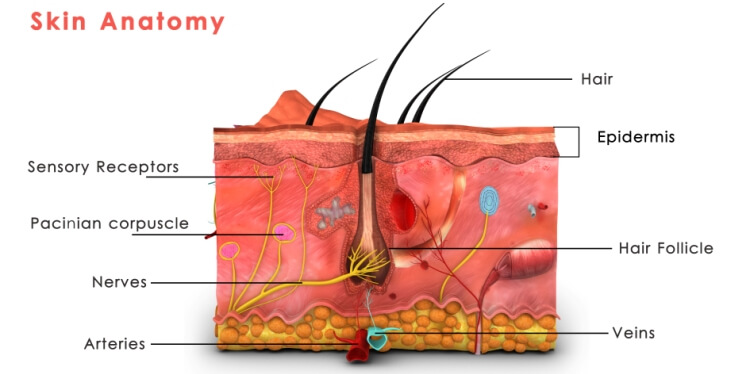
Adult hair has 2 distinct structures – shaft outside the skin, and follicle ( root ) buried under the skin.


Hair Shafts

  The 3 components :
  • Keratin , a hard protein formed by dead cells
  • Binding material
  • Water
The 3 layers :
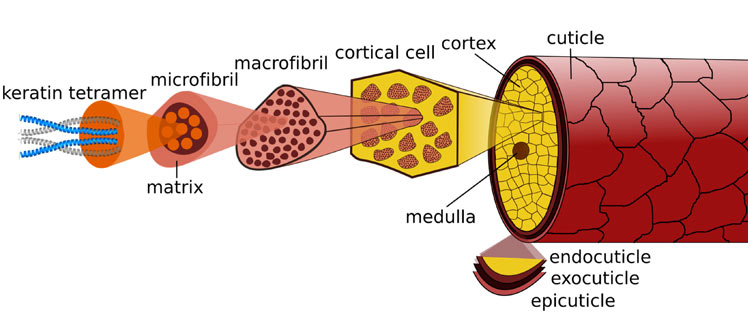
  • Cuticle - a tightly formed structure overlapping scales. A healthy cuticle is a protective layer, and controls the water content of the fiber. Much of the shine that makes healthy hair so attractive is due to the cuticle
  • Cortex - makes up most of the hair shaft, and gives hair its special qualities such as elasticity and curl. Packed with strands of keratin and pigments
  • Medulla - a central hollow core found in terminal hair


hair follicle compartments


Hair Root or Dermal Papilla

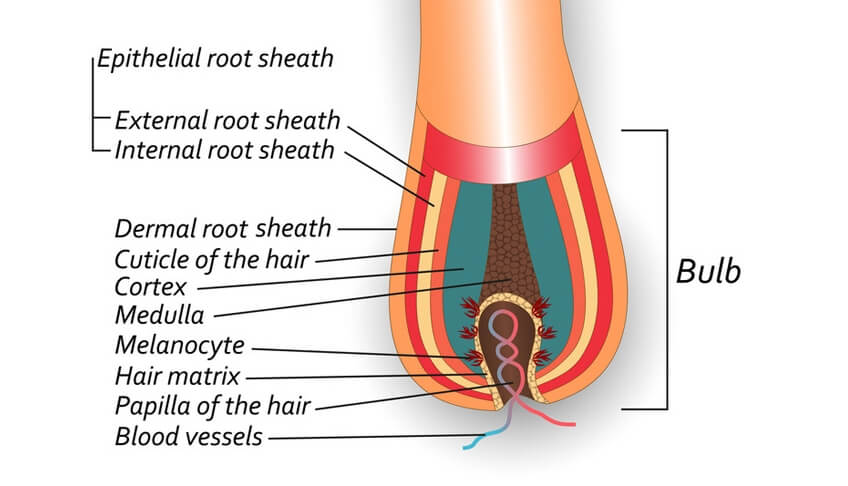
A tunnel-like segment of the epidermis that extends down into the dermis. It can be divided into 2 compartments :

  Vertical Compartments
  • Upper follicle ( infundibulum and isthmus ) - this part is permanent
  • Middle follicle ( the bulge ) - the storage area for hair follicle stem cells that are able to regenerate the hair follicles. This part is also permanent
  • Lower follicle ( the bulb or suprabulbar ) - This forms the dermal papilla which looks like a healthy "pear" shape. This part degenerates and regenerates with each hair follicle cycle. Here the cells are divided 23 to 72 hours to regenerate the hair follicle. This rate of proliferation is the fastest in the body.
Horizontal compartments
  • Outmost connective tissue ( dermal sheath ) - enveloping the hair follicle, this consists of 2 layers :
    • an outer layer called the connective tissue sheath, and
    • an inner layer called the hyaline membrane
  • Outer root sheath ( ORS ) - protect and form the growing hair shaft. Also service as source of energy for protein synthesis during hair growth. Cells found in ORS are :
    • Merkel’s cell
    • Langerhan cells
    • Amelanotic melanocytes
  • Inner root sheath ( IS ) - consists of 3 layers :
    • Henle's layer
    • Huxley's layer
    • Inner root sheath cuticle

Surrounding Tissues
  • Sebaceous gland - opens into the isthmus. This gland secretes sebum, a semi-fluid secretion consisting chiefly of fat, keratin, and cellular material. The sebum lubricates shaft and carries away debris generated in the follicle
  • Arrector pili - a muscle attaches the bulge to the skin. When this muscle contracts, it causes the hair to stand up which also causes the sebaceous gland to secrete oil. This muscle must be cut in FUE to extract the follicle
  • Melanocytes - contain melanosomes and synthesize melanins which account for the pigmentation of hair and skin

Functions of Dermal Papilla
  • Generation of a hair follicle
  • Regulate hair cycle
  • Control the size of the hair shaft
  • Also play a role in hair growth.

Functions of the Inner Root Sheath
  • Protect and form the growing hair shaft
  • Anchor and direct the growth of the emerging hair shaft
  • Determine the racial difference in shaft cross-section
    • Asians – round
    • Africans – flat
    • European - ellipsoidal

Application in Hair Transplant

The bulge contains stem cells, and is thus the most important part in follicle growth and regeneration. During hair transplant this segment of the graft must be well preserved.
  • In FUE, when too small a punch is used, the extracted follicle may deprived of bulge tissue
  • In "Hair Cloning", the dermal sheath of the follicle is cultured in medium. The multiplied tissue is then injected into the skin to induce new hair formation
  • The stem cells in the bulge is also multi-purposes. Hair follicle transplant had shown to return skin color in a skin disease called "vitiligo
  • The average healthy hair fiber diameter is 0.08mm or over. Below 0.04mm the hair fibers are too thin to achieve visual coverage of the scalp. This is called the rescue diameter

Application in Hair Loss Treatment
  • Many treatments are being developed to stimulate the stem cells: new hair follicles can be formed; even white hairs can turn black
  • 5 α reductase converts testosterone into DHT. This enzyme is located in the Sebaceous Glands
  • Dr Inaba (Japan) believes that over consumption of animal fat swells the sebaceous gland, increases the amount 5 α reductase and DHT, leading to earlier onset of androgenetic hair loss

image
image
image