
Lichen Planopilaris (LPP)
Risks & Surgical Contraindications - Patient safety must be priorized through proper medical diagnosis.
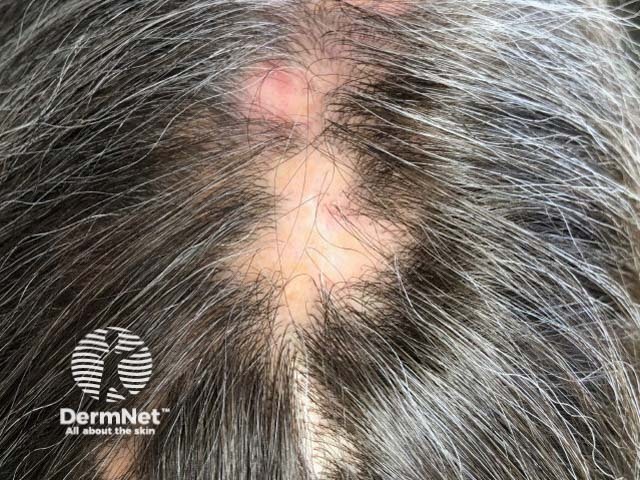
What Is Lichen Planopilaris (LPP)?
Lichen Planopilaris (LPP) is a rare, chronic, and progressive form of scarring alopecia (cicatricial hair loss). It occurs when the immune system mistakenly attacks hair follicles, leading to permanent destruction and replacement by scar tissue.
Key Characteristics
- Irreversible Scarring: Once a follicle is destroyed and replaced by fibrosis, hair cannot regrow naturally or be easily restored.
- Progressive Nature: Without effective medical intervention, the area of hair loss slowly expands over time.
- Inflammatory Activity: Active disease presents with perifollicular erythema (redness), scaling, itching, burning, or pain.
The Danger of Misdiagnosis
LPP is frequently misdiagnosed as Androgenetic Alopecia (pattern hair loss) in its early stages. This delay in correct diagnosis can lead to inappropriate treatments (like transplants) that exacerbate the condition, resulting in catastrophic, irreversible damage to the donor and recipient areas.
What Are the Signs and How Is It Diagnosed?
Recognizing LPP requires identifying symptoms distinct from genetic thinning. A "No Regret" diagnosis strategy is essential.
⚠️ Key Signs & Symptoms
- Sensory Symptoms: Persistent itching, burning, tenderness, or pain on the scalp (uncommon in pattern loss).
- Visual Signs: Perifollicular erythema (redness around follicles) and hyperkeratosis (scaling/tubular casts).
- Patchy Loss: Irregular bald spots with a smooth, shiny appearance indicating scar tissue (loss of follicular ostia/pores).
- "Lonely Hair" Sign: Isolated terminal hairs remaining within a patch of scarring alopecia.
- Distribution: Often starts at the crown or vertex but can affect the frontal hairline (Frontal Fibrosing Alopecia variant).
✅ Diagnostic Protocol
Accurate diagnosis is non-negotiable before any treatment discussion.
- Scalp Biopsy (Essential): A 4mm punch biopsy from the active edge of hair loss is required to histologically confirm lymphocytic inflammation and scarring.
- Trichoscopy: Dermatoscopic examination to visualize perifollicular scaling, loss of follicular openings, and vascular patterns.
- Medical History: Evaluation for associated conditions like oral lichen planus, skin lesions, or nail changes.
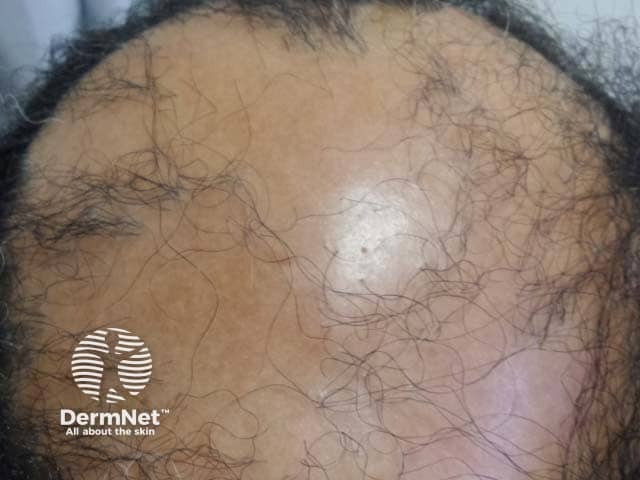
Why Is Hair Transplant Contraindicated in Active LPP?
Warning: Considering a hair transplant without ruling out LPP via biopsy risks catastrophic, irreversible damage to the donor area and recipient site. Never proceed with surgery based on visual inspection alone.
The fundamental medical ethic is "first, do no harm." For Lichen Planopilaris, this means surgery is almost universally contraindicated during active disease phases.
The Koebner Phenomenon
The primary risk is the Koebner phenomenon, where physical trauma to the skin (such as needle insertions during grafting) triggers new LPP lesions at the site of injury. This can result in:
- Destruction of Grafts: Transplanted follicles are attacked and destroyed by the reactivated immune response.
- Loss of Native Hair: Surrounding healthy native hair in both recipient and donor areas can be permanently lost.
- Expanded Scarring: The area of alopecia may rapidly enlarge beyond the original boundaries.
Absolute Contraindications
Surgery is strictly prohibited if:
- There is any sign of active inflammation (redness, scaling, itching, pain).
- Bald patches are visibly expanding.
- A recent biopsy shows active lymphocytic infiltrate.
- New hair loss has occurred within the last 24 months.
When Might Surgery Be Considered? (Rare Exceptions)
Transplantation is viewed as a high-risk exception, only discussable after rigorous, long-term validation of disease quiescence.
1. Proven Inactivity (≥2 Years)
Minimum 24 months of zero symptom progression, no new hair loss, and no clinical signs of inflammation.
2. Clear Follow-Up Biopsy
A repeat biopsy must confirm the absence of active perifollicular inflammation and scarring activity.
3. Stable Medical Therapy
Patient must be on a consistent, effective maintenance regimen (e.g., hydroxychloroquine) to suppress immune activity.
4. Realistic Expectations
Full understanding that graft survival may be compromised and reactivation remains a lifelong possibility.
💡 Even when these criteria are met, the procedure carries significant risk and is performed only by specialists experienced in scarring alopecia.
What Is the Primary Treatment for LPP?
The immediate goal is halting disease progression and preserving existing hair, not restoration.
💡 Anti-Inflammatory Therapy
- First-Line Agents: Topical corticosteroids, intralesional steroid injections, and systemic medications like Hydroxychloroquine or Doxycycline.
- Immunomodulators: In refractory cases, agents like Cyclosporine, Mycophenolate Mofetil, or Pioglitazone may be utilized.
- JAK Inhibitors: Emerging evidence supports the use of topical or oral JAK inhibitors for resistant cases.
💡 Long-Term Monitoring
- Symptom Tracking: Regular assessment of itching, burning, and pain levels.
- Photographic Documentation: Serial standardized photos to detect subtle expansion of alopecic patches.
- Trichoscopic Follow-up: Periodic exams to monitor perifollicular scaling and erythema.
- Goal: Achieve and maintain clinical quiescence before considering any cosmetic interventions.
Critical Safety Warning
- Permanent Destruction: LPP replaces follicles with scar tissue; lost hair cannot regrow. Early diagnosis is vital to preserve remaining hair.
- Surgical Contraindication: Hair transplantation is prohibited during active inflammation. Trauma triggers the Koebner phenomenon, worsening the condition.
- Rare Exceptions Only: Surgery is contemplated only after ≥2 years of proven quiescence (inactive disease), confirmed by serial biopsies and clinical stability.
- Medical Priority: The primary goal is halting immune attack via anti-inflammatory therapy (e.g., hydroxychloroquine, steroids), not restoration.
- Misdiagnosis Risk: LPP is often mistaken for genetic thinning. A biopsy is mandatory before considering any surgical intervention.