
Understanding Hair Loss : Causes, Diagnosis & Management
A comprehensive clinical guide to the pathophysiology of hair loss, ranging from genetic predisposition to autoimmune conditions, emphasizing accurate diagnosis as the prerequisite for effective treatment.
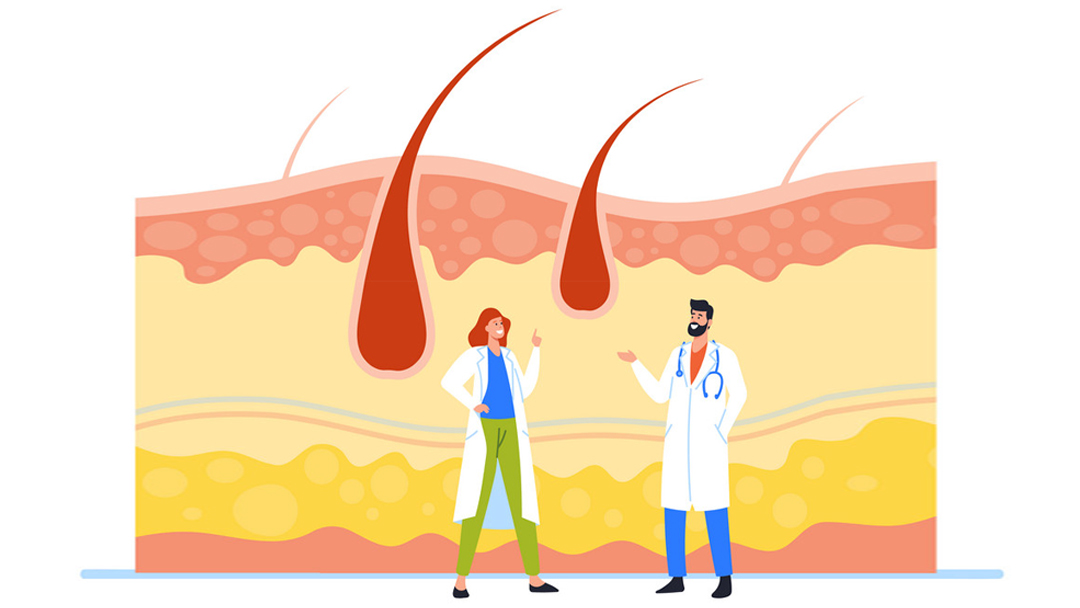
Fundamentals of Hair Biology
Understanding the physiological basis of hair growth is essential for evaluating any hair loss condition or treatment modality.
Application of Hair Science
How hair biology knowledge guides treatment decisions and transplant planning for optimal results.
Click To Read MoreThe 5 Phases of the Hair Cycle
Understand anagen, catagen, telogen, exogen, and kenogen phases and their clinical significance in shedding and growth.
Click To Read MoreHair vs. Follicular Unit vs. Graft
Key differences that affect transplant planning, graft counting, and setting realistic patient expectations.
Click To Read MoreDHT & 5-Alpha-Reductase
Dihydrotestosterone (DHT) is the primary mediator of genetic pattern hair loss, causing follicular miniaturization.
Click To Read MoreCommon Etiologies of Hair Loss
The following conditions account for the majority of cases presented in clinical practice.
Androgenetic Alopecia (AGA)
The most prevalent form, characterized by progressive thinning in a defined pattern due to genetic sensitivity to androgens.
Click To Read MoreTelogen Effluvium (TE)
Temporary, non-scarring shedding triggered by systemic stressors such as illness, surgery, pregnancy, or rapid weight loss.
Click To Read MoreAlopecia Areata (AA)
An autoimmune condition causing sudden, patchy hair loss. Requires medical management before any surgical consideration.
Click To Read MoreScarring Alopecias (Cicatricial)
Permanent loss from burns, trauma, or inflammation. Transplant can restore coverage once the condition is stable.
Click To Read MoreTraction Alopecia
Hair loss caused by chronic physical tension from tight hairstyles. Early stages are reversible; late stages result in scarring.
Click To Read MoreScalp Psoriasis
A chronic autoimmune skin condition that can mimic or complicate hair loss diagnosis, requiring specific dermatological management.
Click To Read MoreUncommon and Complex Conditions
Less frequent etiologies require specialized diagnostic protocols and tailored therapeutic approaches.
Anagen Effluvium
Rapid hair loss occurring during the growth phase, typically induced by chemotherapy or radiation. Usually reversible post-treatment.
Click To Read MoreTrichotillomania
A psychological disorder characterized by an irresistible urge to pull out one's hair. Behavioral therapy is primary; surgery is contraindicated.
Click To Read MoreLichen Planopilaris (LPP)
Progressive inflammatory scarring alopecia. Surgery is strictly contraindicated during active phases.
Click To Read MoreFrontal Fibrosing Alopecia (FFA)
A variant of LPP affecting the hairline. Transplant only considered after prolonged stability confirmed by biopsy.
Click To Read MoreTriangular Alopecia
A congenital, non-progressive patch of hair loss in the temporal region. Stable and highly amenable to surgical correction.
Click To Read MoreClinical Diagnostic Workflow for Hair Loss Evaluation
Hair loss is a symptom, not a single disease. It manifests through various mechanisms, each requiring a distinct therapeutic approach. Accurate Diagnosis is the Critical First Step.
Physician-Led Consultation
A comprehensive medical history and physical examination by a qualified doctor are mandatory to diagnose pathology.
Click To Read MoreTrichoscopy & Digital Analysis
Digital scalp microscopy visualizes hair shaft diversity and vascular patterns, distinguishing scarring from non-scarring loss.
Click To Read MoreLaboratory Workup
Blood tests to rule out systemic causes like iron deficiency, thyroid dysfunction, vitamin D deficiency, or hormonal imbalances.
Click To Read MoreScalp Biopsy
In unclear cases, a 4mm punch biopsy provides histological confirmation of the disease process.
Click To Read MoreTreatment Modalities &Care
Evidence-based interventions fall into five primary categories, each serving a specific clinical purpose. Therapeutic strategies are dictated by the specific diagnosis. A multimodal approach often yields the best results.
1. Pharmacological Therapy
FDA-approved medications (e.g., finasteride, minoxidil) and others (dutasteride, ketoconazole, RGA, Fresh Frozen Plasma, Lysosome ... ) to halt progression and stimulate regrowth in hair loss.
Click To Read More2. Surgical Restoration - Hair Transplant
Hair transplantation is the gold standard for restoring density in stable, permanent hair loss where donor supply is adequate.
Click To Read More3. Scalp Micropigmentation (SMP)
Non-surgical cosmetic tattooing mimicking shaved hair follicles. Advantage : Immediate results, no downtime, suitable for advanced loss.
Click To Read More4. Low-Level Laser Therapy (LLLT)
LLLT may support graft survival and native hair health as part of a comprehensive plan.
Click To Read More5. Cosmetic Camouflage
Temporary visual coverage without treating the underlying cause. Types includes Keratin fibers, concealing sprays, wigs, and hairpieces.
Click To Read MoreThe Psychosocial Impact of Male Hair Loss
For men experiencing androgenetic alopecia, hair transplantation is the only permanent solution that directly restores both physical hair density and a foundational aspect of self-image.
Click To Read MoreDaily Care Protocols
Proper hygiene, gentle styling, and UV protection are essential to maintain scalp health and protect existing hair shafts.
Click To Read MoreSummary of Strategic Approach
Successful hair restoration relies on a logical, step-by-step methodology:
1. Diagnose
Confirm the specific etiology (genetic, autoimmune, etc.) through professional medical evaluation.
2. Stabilize
Use pharmacological therapy to halt active shedding and preserve existing hair before considering restoration.
3. Restore
If candidate criteria are met, proceed with surgical transplantation or SMP for permanent aesthetic improvement.
4. Maintain
Commit to long-term maintenance protocols to protect both native and transplanted hair over a lifetime.